Showing posts with label Chattooga River. Show all posts

Monday, May 4, 2026

The Magnificent Chattooga River

Chattooga River
Chattooga National Wild & Scenic River

I spent a recent day fishing the Chattooga River with a friend. We chose a fairly remote section that required modest hikes in and out and a couple of miles of trekking through the riverbed.

Occasionally, I need to pause to ponder what a blessing it is to have the Chattooga National Wild & Scenic River so close to home. The Chattooga rises high on Whiteside Mountain in Western North Carolina and runs nearly its entire course through forested public land on the Nantahala, Chattahoochee, and Sumter national forests. Wild and Scenic River designation protects the river corridor from development or road encroachment.

I’ve spent dozens of day — maybe more than 100 — fishing, hiking and rafting along the Chattooga. I’ve camped by the river, explored wild and unforgiving areas like Rock Gorge and the Canyon of the Five Falls, but most days have been spent fishing for trout and/or Bartrams bass.

Part of the appeal of the Chattooga from an angling perspective is the diversity of opportunities. 

The far upper section is pure wild trout waters, with wild native brook trout if you go far enough up.

The sections around Burrells Ford is heavily stocked. Below the bridge is a long section that contains a mix of helicopter stocked rainbows, wild rainbows and brown and “semi-wild” brown that are helicopter stocked as subadults during late fall and grow up in the river like wild fish. 

The three miles above the Highway 28 bridge are managed with delayed harvest regulations. Below 28, some trout get stocked in a couple of areas, but Bartrams bass are more prevalent.

The Chattooga also offers tremendous variety in its character, although changes are throughout the river as opposed to differing by major section. From high in the mountains to the lower reaches, where the Chattooga is large for an Appalachian mountain river, it continuously shifts from broad, shallow runs to long, deep pools to crashing rapids, a few of which are better described as waterfalls.

The common denominator is that the river is stunning, with a backcountry feel and water that stays clear even after most rains. It also has a backcountry feel nearly throughout, and several areas are only accessible via significant walking or skilled paddling.

The Chattooga also has an extraordinary network of tributaries that include some of my favorite places in Georgia, but that’s probably another story for another time!

Friday, April 24, 2026

Bonus Backcountry Bartrams Bass

Bartrams bass
Chattooga River Bartram's bass

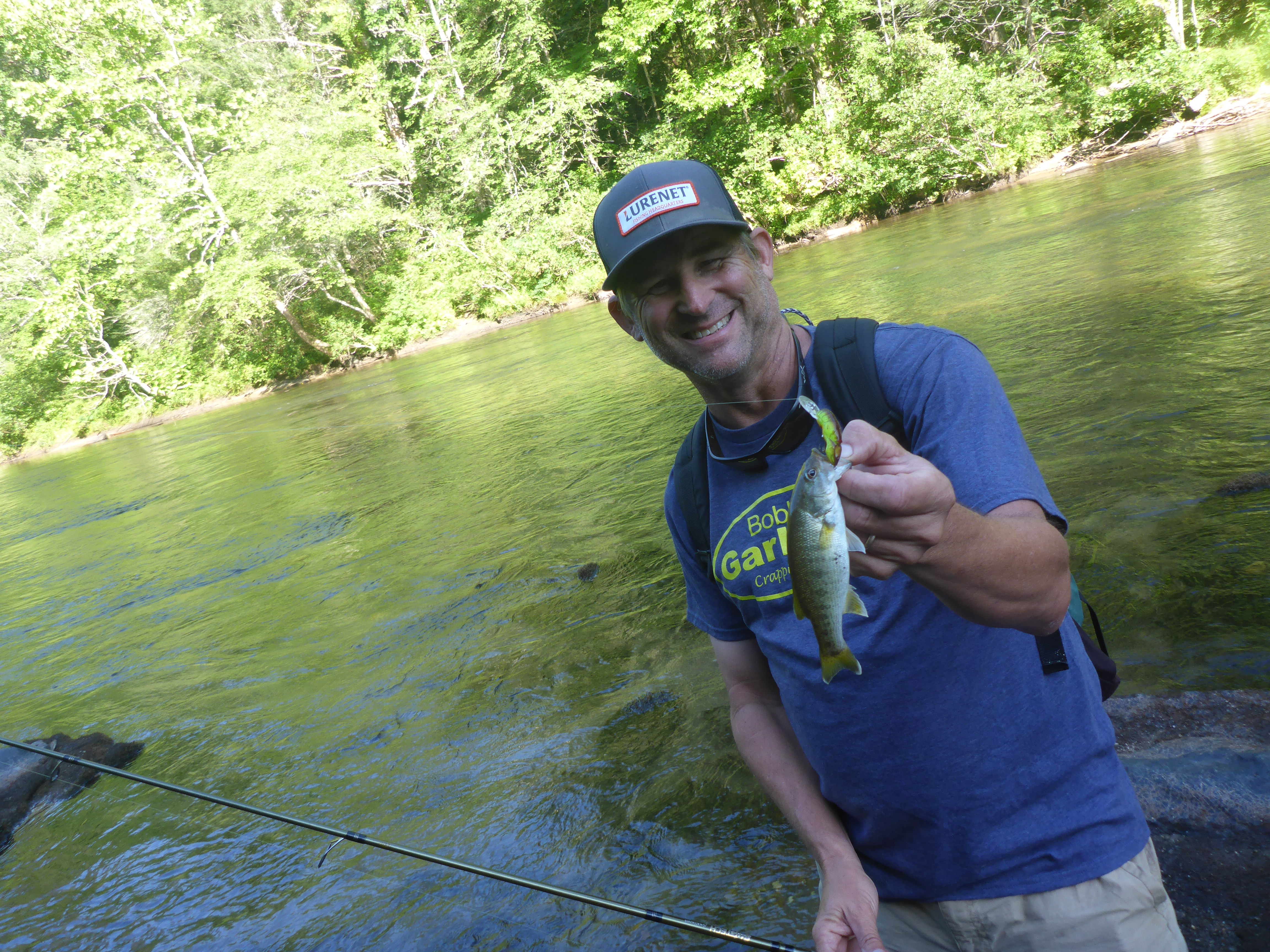
Rainbow and brown trout were the target species during a recent wade-fishing trip, and we caught plenty of them. Bartrams bass were a bonus — an excellent bonus from my standpoint.

I wasn’t shocked to catch Bartrams bass. I’d caught them from the same section of the Chattooga River before — while fishing with the same friend, in fact. And I’ve caught many Bartrams farther downstream on the same river. I did not expect to catch enough bass to lose count, but that’s exactly what happened.

Interestingly, I think I could have caught far more. The Bartrams mostly came late in the day. We were fishing through a section of remote river and needed to keep moving to ever get to where we could reasonably get out and connect with a trail. I was casting while walking and in places getting at least one hit on almost every cast.

I’m a huge fan of Bartrams bass. While they don’t grow very large, they are feisty and fun to catch and ways have fabulous markings.

Bartrams bass, by the way, are upland black bass — one of the redeye species — and they are only found in the upper Savannah River watershed. Hybridization with non-native Alabama bass and spotted bass has substantially reduced their range over the years. Select water still have strong populations, though.

The trout also served up big fun, but that’s another story! To see the river and catches of trout and bass, check out “Brown Trout, Rainbows & Bartrams Bass — Walk-in Fishing Adventure” on Fishing on Foot YouTube.


Sunday, January 4, 2026

First Fish of 2026


Something just doesn’t seem right when we get well into January and I realize that I have not yet caught a fish in the new year. Not wanting to risk that and having no other plans on New Year’s morning, I decided to make a river run.

Temps were in the 20s, and the river was extremely low and clear — not ideal catching conditions — but it’s a heavily stocked section with a catch and release requirement this time of year, so I knew there would be plenty of fish available.

Interestingly, despite ice forming on my line guides every few casts, I found a few fish rising on something too small to see in one of the first pools I fished. Trout were swiping at my lures but wouldn’t quite commit, despite me changing my offering a couple of times. 

I decided to move along to see what else I could find. A couple hours later, having found nothing else, I began wondering if I’d moved from that spot too quickly. And with more anglers arriving, I was even questioning whether I would end up getting my first fish of the year.

Thankfully, my concerns were overplayed. I eventually found the right cast and presentation and caught a couple of brown trout with essentially the same cast. Landing - Lindy Quiver Spoon in a current line across the river, letting tumble in the current, and the snapping it upward, near the bottom was the ticket.

A little farther upstream, I found a rainbow that took a Bobby Garland Mayfly. Then, on the way out, I stopped back by the pool where I saw morning activity and was able to coax one of those fish — a pretty rainbow— into grabbing my Mayfly. 

I only fished the morning, and can’t claim I just tore ‘em up. However, it was a fun New Year’s morning, and I was happy to tally my first two species of 2025: brown trout and rainbow trout.


Sunday, November 6, 2022

Chattooga River Bartrams Bass


 One of my favorite fishing outings, and one I try to make at least a few times every year, is a hike-in wading trip on the Chattooga National Wild and Scenic River to fish for Bartrams bass. I’ve only made two trips this year, and the season if quickly passing for the way I like to fish, so that might be it for 2022.

If you don’t know Bartrams bass, they are one of several species of black bass that are collectively called redeye bass. When I first started chasing these fish, nearly three decades ago, they were categorized as shoal bass, but there was no explanation as to why shoal bass in other areas grew substantially larger. Then they were recognized as redeyes, but lumped with Coosa redeye bass. More recently, biologists recognized redeyes in the Savannah River watershed as genetically distinct and named them Bartrams bass.

There’s no hot section of the Chattooga for these fish, from my observation. I’ve caught them well up into trout waters and at the far lower end of the river run and have found similar success throughout. Numerous trails and a couple of roads provide access in different areas, from Georgia and South Carolina. River levels, the amount you are willing to do and the character of stream you seek are better determinants for the best section for any given day. 

Some areas are pretty easy to access with a short walk and well suited for quick outings. Others can only be reached with a lot of walking, wading, rock hopping, climbing etc. Some areas have no practical fishing access.

I keep my fishing approach simple for these fish, wading wet and carrying a single light or ultralight spinning outfit and a small box of lures that I can put on a backpack or vest pocket. I like small, crawfish-imitating crankbaits, topwater lures and small soft plastic baits. If I could have only one bait for this fishing it would be a Rebel Deep Teeny Wee Crawfish. Top producers on this year’s outings were the new Bobby Garland Mayfly and a Bomber 6A.

It’s important to note that much of the Chattooga corridor is rugged and remote, and currents, vertical drops, slippery rocks and more can be dangerous. Water levels are also ever changing, totally changing the river’s character and accessibility. 

A fishing license is required, but a reciprocal licensing agreement makes either a valid Georgia or South Carolina license valid anywhere on the river.

Tuesday, July 20, 2021

Don't Overlook Chattooga River Bass

Chattooga River Redeye Bass

When folks think about fishing the Chattooga National Wild & Scenic River, trout normally come to mind. That's reasonable. This river supports an excellent and diverse trout fishery, and trout are certainly the sport fish most associated with clear, cold mountain rivers. However, the lower portion of the Chattooga also offers fun fishing for Bartrams bass, a type of black bass that was only recently identified as a distinct species.

I've been wading the lower Chattooga for river bass from time to time for many years, and when I first started fishing for them, they were believed to be shoal bass that simply didn't grow as large as the ones in the Flint and Chattahoochee rivers. After that, they were separated from the shoal bass and re-classified as Coosa redeye bass. More recently, biologists have identified the redeyes in the upper Savannah watershed as Bartrams bass.

Whatever you want to call them, these are feisty river bass that are fairly plentiful from the lower end of the primary trout waters (around Highway 28) all the way to where the river backs into Lake Tugalo. There's no hotspot or even a prime section, from my experience. They are nicely distributed through the lower river, and different stretches will be good on different days. I pick my spot most days based on the section of river I want to see that day.

Because of Wild & Scenic River protection, most access to the Chattooga calls for a least a bit of walking. That's OK, though. The remoteness is a major part of the fun. Several hiking trails or boating access points on both the Georgia and South Carolina banks lead to places you can get in and wade. Because of rapids and remoteness, wading the lower Chattooga River calls for significant caution, and is best done with a fishing partner. Generally speaking, this fishing is best suited for fairly low flows.

I keep my river bass fishing very simple, wet wading in shorts and a tee-shirt and carrying a small backpack with a handful of lures, drinks, snacks and a few extra items, like pliers and sunscreen. Various lures will catch these bass, but my definite go-to is a Rebel Deep Teeny Wee-Crawfish, which matches common forage and can dig down in pools or grind along gravel bars.

Bartrams bass aren't big. A 12-incher is somewhat noteworthy. However, they are big in spirit and very fun to catch.

Bartrams bass


Sunday, July 8, 2018

Upcountry Kayak and Wading Excursion

Asher and I had a big time exploring waters in the South Carolina's Upcountry not too long ago. We fished mostly from the kayaks, but also spent part of a day wading the Chattooga National Wild & Scenic River.

The kayak element was extra fun because it represented somewhat of a test run. It was the first time I had loaded up both Vapor 10 Anglers for an outing to nearby waters since I brought the second one home from Old Town. We hit three different lakes by kayak, meaning 13-year-old Asher and I loaded and unloaded both boats multiple times in a couple of days, and doing so was every bit as quick and simple as I had hoped. Of course, I knew both kayaks would suit my needs well on the water because the new one is the same model as the I already had -- just a different color.

We spent time in the kayaks fishing Tugaloo Lake, Lake Jocassee and Lake Oolenoy, all tucked in the mountains and beautiful, but each distinctive in character. All three yielded some fish to go along with great paddling opportunities. 

We began on Tugaloo, which straddles the South Carolina/Georgia border and is fed by the Chattooga River and by the Tallulah River at the extreme lower end of Tallulah Gorge. We launched on the South Carolina side and spent the morning hitting pockets off the Chattooga River arm. We didn't end up traveling far because we began catching bass and bluegills almost immediately and never had need to do much searching. That said, I want to return some time soon with a whole day available to paddle down Chattooga and all the way up the Tallulah arm to fish inside the gorge section.

Next we visited Lake Jocassee, which is arguably the most scenic lake in the Southern Appalachia. Located at the edge of the Blue Ridge Escarpment, Jocassee is crazily rugged, steep, clear and deep. Most tributaries enter the lake as waterfalls, and it's nothing to be sitting over 200 feet with the boat a cast's distance from the shore. 

Our Jocassee exploration was greatly aided by Jocassee Lake Tours. Owner Brooks Wade welcomed kayaks, Asher and me onto one of the company's pontoons and took us to a few select areas of the lake that he knew would be extra cool to explore, would lend themselves to great photo opportunities and might produce a few fish. Jocassee Lake Tours
doesn't do guided fishing trips, and ultra-clear lakes can be challenging in mid-summer, so he made no promises on the fishing part. That said, we managed to catch several bluegills while paddling in some seriously beautiful areas. 

The third kayaks stop, Lake Oolenoy, is in Table Rock State Park, and the park's namesake rocky-faced mountain provides a spectacular backdrop to many parts of the lake. Only electric motors are permitted on Lake Oolenoy, and the lake is a nice size for a day of kayak fishing. It's small enough to fish your way around in a modest day, but large enough that there is room to explore and for several anglers to fish it at the same times. The bass bite was good at Oolenoy. We didn't catch big fish, but we caught quite a few bass. Making a good thing even better, the bass were coming up and blasting Pop-Rs on the surface!

We capped off our summer Upcountry tour by wading the Chattooga in a few different areas and catching both redeye bass and trout. Little is more fun in my mind than wet wading a cool mountain stream on a hot day and throwing little lures like Rebel Crawfish on ultralight gear for a mixed catch, so doing just that made for a fine trip finale.


Wednesday, April 27, 2016

Knee Deep For Redeyes

I don't know that I can quite state a certain favorite style of fishing, but it very well might be wading wet in a free-flowing mountain river and casting ultralight lures for either trout or stream bass. Last week, I spent a fun day with a friend from Colorado doing exactly that in the cool, clear waters of the Chattooga National Wild & Scenic River.

We cast for Coosa redeye bass, which are native to the Chattooga and fairly plentiful in the lower river. We didn't catch crazy numbers (five or six, I think), and none were huge. However, we got just enough action to keep things interesting while wading a couple of beautiful sections of river. All the redeyes and one big chub came on Rebel Teeny-Wee Craws.

Both the redeyes and the chub were new catches for me for this year. The 2016 tally is now at 23 species. Of those, six are different black bass species (Guadalupe, Suwannee, largemouth, smallmouth, spotted and Coosa redeye bass) caught this spring on Rebel Crawfish. I still need a shoal bass, but fortunately some of those swim in waters that are close to home.

Friday, January 8, 2016

Less Traveled Waters

I admit that I tend to gravitate toward delayed harvest trout waters this time of year. Because of heavy stockings and the catch-and-release requirement, the fish are normally there, and sections of several rivers are sufficiently familiar that it's easy to set a plan. I'm far from alone in that, though, and those same waters get a lot of attention.

Yesterday Asher and decided to fish well upstream of the delayed harvest section of the Chattooga River, mostly because the river was still quite high from this winter's rains, and I felt like the character of the upstream section was better suited for wading along the edges. It's also a section that holds a lot of brown trout that are typically tough to catch, and I thought that high flows on a dark January day might make the browns a little feistier than normal.

Both things turned out to be true, which of course is a good thing, but an added benefit was that we never saw anyone else in the river. Once pair of backpacking anglers were unloading their car when we were, and we saw their campsite and passed them on the trail once. We also greeted one solo angler who was gearing up as we walked from the car to the river. No one in the river, though, and we worked about a mile upstream and fished for probably six hours.

I guess I can't say this for certain because I wasn't there, but I'll bet it wasn't that way in the DH section, even with the high flows. I wasn't really thinking about getting away from crowds when I picked our spots, but I have to say that it was refreshing, and I'm going to be more intentional about thinking about some of those "other waters" for future cool-season outings.

Friday, January 16, 2015

Chattooga Trout Slam

My first trout outing of the new year yielded my first trout slam of the year, with one or more brook, brown and rainbow trout all having cooperated. All came on a Kenneth Bug, which is what I call any hair jig tied primarily with fur from our dog Kenneth.

Nathaniel, Brian Latimer and I fished the Chattooga River, which forms the border between Georgia and South Carolina. The rainbow and brook trout were Georgia fish, which means that the first four fish added this year's species list (bluegill, largemouth bass, rainbow trout, brook trout) all came from Georgia. I have the brown trout listed as South Carolina, as of now, but the jury remains out about how it should be counted. I was standing in South Carolina, close to the bank, but I cast across the river into Georgia and the fish hit right away.

It was a fun and productive outing, and I'm glad we were able to slip out. Next fishing for me will be next week on the ice in Pennsylvania. I drive north on Monday and expect to be on the ice first thing Tuesday morning. Seems likely that my species list will grow a bit more next week.

Monday, June 16, 2014

Species 19 & 20

Yesterday's swing to the Chattooga National Wild & Scenic River yielded Nos. 19 and 20 for my 2014 Species List. No. 19 was a redeye bass. Redeyes are regionally distinctive black bass that look and act like mini smallmouths. No. 20 was a chub. Spend enough days casting in mountain rivers, you'll eventually find your chub most years.

I've noted before that while I've caught lots of pond and stream fish in from Georgia this, none of my list fish, which are the first of any given species in a year, have come from my own state's waters. This year's list now includes fish from nine states, but none from Georgia! Yesterday was the closest. The chub actually might have even been in Georgia when it hit. I was wading on the SC side of the border-straddling river, though, and I don't even know if my  cast crossed the middle (or exactly where the line runs in that area) so I still had to record it as a South Carolina fish.

I don't know what species will make the list next, but part this weekend's fishing plan in Wisconsin is to go after salmon, and any salmon species would add to this year's list.

Thursday, July 19, 2012

Backyard Treasures


As my daughter and I began hiking the Hurricane Falls Trail at Tallulah Gorge State Park this afternoon, I realized it had been a few years since I'd hiked in the park and that Sarah had never hiked to the suspension bridge that spans the gorge above the falls' main drop, let alone continuing to the base of the falls. How easy it is to forget about the beautiful places that are so close to home.

A narrow 1,000-foot-deep gorge that flanks the Tallulah River as it pours over four major waterfalls, Tallulah Gorge is only 15 miles from my house, and the spectacular hike to Hurricane Falls really doesn't take long to complete. I'm blessed to live at the edge of the Appalachian Mountains, to enjoy the schedule control that comes from self employment and to have a wife and children who enjoy exploring God's creation. It's pretty silly, therefore, to not spend more time exploring places like Tallulah Gorge, Amicalola Falls and the Chattooga National Wild and Scenic River.

Even today, we only ended up planning a gorge hike because Sarah wanted reference pictures of Hurricane Falls for a pressed flower picture she hopes to do at some point. We gained much more than a few pictures from the hike, though, and I'm thankful for the motivation to get on the trail and the reminder about the treasures that are so close to home.

Friday, June 29, 2012

New Fishing Agreement Between Georgia and South Carolina

From Ellicott Rock, where the Chattooga River exits North Carolina, to the mouth of the Savannah River, where the big river meets the Atlantic Ocean, water forms the entire border between Georgia and South Carolina. Whether as a tumbling trout stream, Piedmont impoundment, twisting river or marsh-bound tidal flow, the water along the border provides plentiful fishing opportunities that are shared by anglers in both states.

Realizing the mutual benefit of this shared resource, Georgia and South Carolina have long operated under a reciprocal fishing agreement, which allows anglers properly licensed by either state to fish anywhere on the border waters, whether by boat or from the bank. Recent changes in South Carolina's fishing laws called for a re-working of the agreement, with some changes in Georgia's sport fishing limits. The new agreement goes into effect July 1 (this Sunday).

"Anglers as well as state officials on both sides wanted to continue the fishing license agreement and keep fishing regulations as similar as possible on border waters," said John Biagi, Chief of Fisheries Management for the Georgia Wildlife Resources Division. "To minimize confusion, Georgia sport fishing regulations will largely mirror South Carolina laws on border waters."

New limits for water on either side of the border include a combined 10-fish limit for stripers and hybrids in lakes Hartwell and Clarks Hill (Thurmond), a five-fish trout limit and a 10-fish white bass limit. It's worth noting that limits for crappie and bream are not unified, with larger harvests permitted in Georgia waters.

For details, visit the regulations page at gofishgeorgia.com.

Saturday, May 5, 2012

Total Chattooga Experience

The Chattooga River is best known for its steep, technical and powerful rapids (well, that and for being the filming site for the movie Deliverance) -- but a trip down Section IV of the Chattooga National Wild & Scenic River isn't just a wild ride. The pools are as spectacular as the rapids, and highlights that stand out in most rafters' minds include the side trip to Long  Creek Falls and paddling beside Raven Cliffs. Yesterday our group had the river to ourselves from start to finish, which is more the norm than the exception, and we enjoyed the bonus of catching the mountain laurel in full bloom. Rafting the Chattooga has such a wilderness feel that it's really hard to believe you're only two hours from Atlanta. To learn more, visit Southeastern Expeditions.

Friday, May 4, 2012

Chattooga Whitewater This Morning

Photo courtesy of Southeastern Expeditions

Less then five hours from now, Nathaniel and I will be helping tote rafts and other gear into the gorge of the of Chattooga National Wild & Scenic River for a trip down Section IV! This section pours through several steep and technical Class III to V rapids and finishes with  Five Falls, which is a string of five big big rapids. Remote, rugged and strikingly beautiful, Section IV twists and turns among house-sized boulders, forested slopes and sheer cliffs. I'm really excited about this morning's outing because I haven't rafted the river for several years, and Nathaniel has never been down it. I'm bringing my little waterproof point-and-shoot and my GoPro, so I have big hopes of returning with some cool photos and hopefully some videos as well.