Showing posts with label Rebel Crawfish. Show all posts

Tuesday, July 20, 2021

Don't Overlook Chattooga River Bass

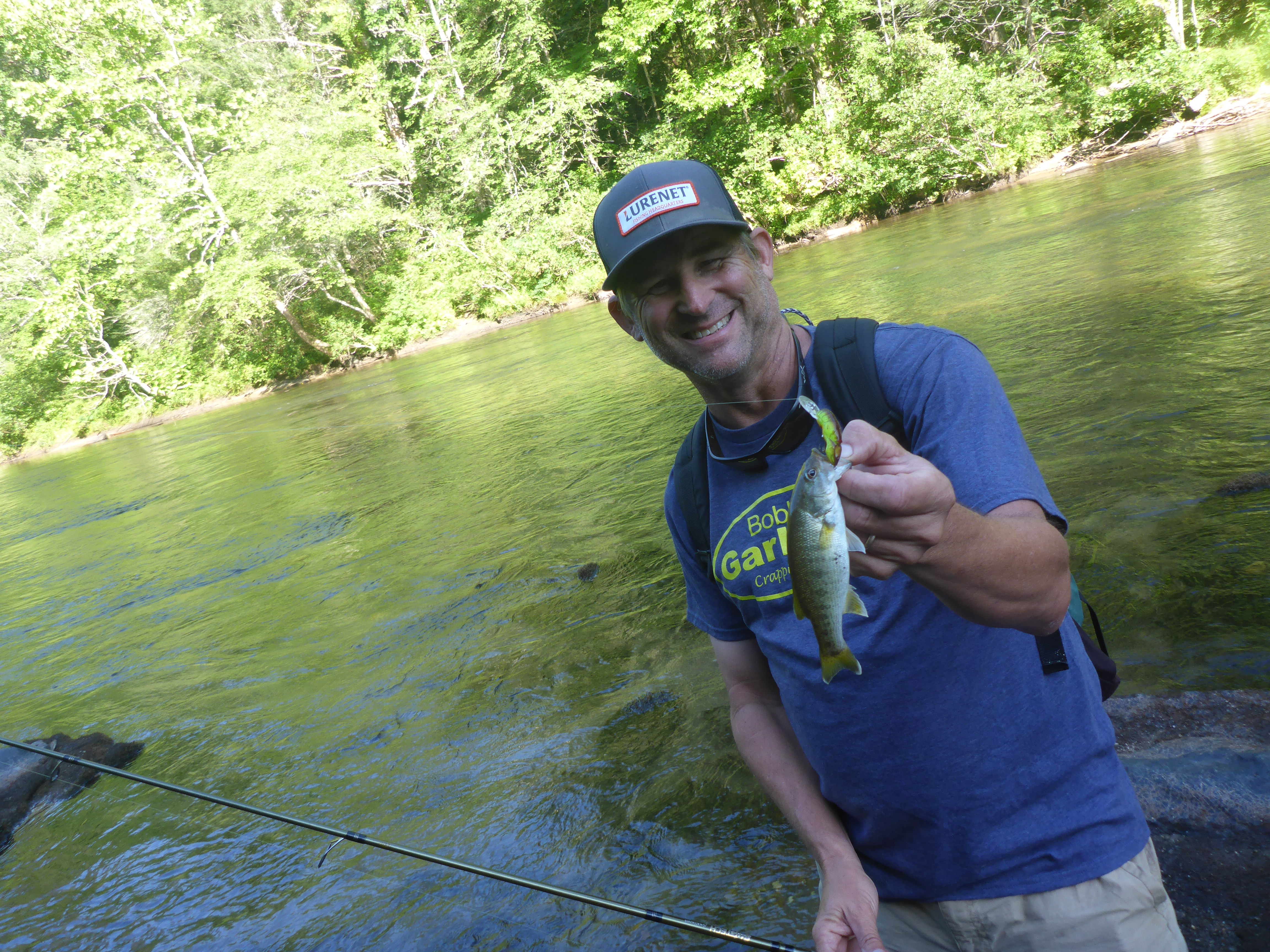
Chattooga River Redeye Bass

When folks think about fishing the Chattooga National Wild & Scenic River, trout normally come to mind. That's reasonable. This river supports an excellent and diverse trout fishery, and trout are certainly the sport fish most associated with clear, cold mountain rivers. However, the lower portion of the Chattooga also offers fun fishing for Bartrams bass, a type of black bass that was only recently identified as a distinct species.

I've been wading the lower Chattooga for river bass from time to time for many years, and when I first started fishing for them, they were believed to be shoal bass that simply didn't grow as large as the ones in the Flint and Chattahoochee rivers. After that, they were separated from the shoal bass and re-classified as Coosa redeye bass. More recently, biologists have identified the redeyes in the upper Savannah watershed as Bartrams bass.

Whatever you want to call them, these are feisty river bass that are fairly plentiful from the lower end of the primary trout waters (around Highway 28) all the way to where the river backs into Lake Tugalo. There's no hotspot or even a prime section, from my experience. They are nicely distributed through the lower river, and different stretches will be good on different days. I pick my spot most days based on the section of river I want to see that day.

Because of Wild & Scenic River protection, most access to the Chattooga calls for a least a bit of walking. That's OK, though. The remoteness is a major part of the fun. Several hiking trails or boating access points on both the Georgia and South Carolina banks lead to places you can get in and wade. Because of rapids and remoteness, wading the lower Chattooga River calls for significant caution, and is best done with a fishing partner. Generally speaking, this fishing is best suited for fairly low flows.

I keep my river bass fishing very simple, wet wading in shorts and a tee-shirt and carrying a small backpack with a handful of lures, drinks, snacks and a few extra items, like pliers and sunscreen. Various lures will catch these bass, but my definite go-to is a Rebel Deep Teeny Wee-Crawfish, which matches common forage and can dig down in pools or grind along gravel bars.

Bartrams bass aren't big. A 12-incher is somewhat noteworthy. However, they are big in spirit and very fun to catch.

Bartrams bass


Monday, July 16, 2018

Favorite Fishing Destinations Countdown: No. 4 - White River, Arkansas

Cranor's Guide Service
The Bull Shoals tailwater is about a 12-hour drive from my house, and there truly is no practical flying option for most travelers. (If you happen to own a small plane, you fly directly to Gaston's!) Despite the long drive, I've always visited the White River as often as have had the opportunity, and if such an opportunity were to arise, I'd happily hop in my car and make the trek as quickly as I could pack my bags and load appropriate gear!

The trout fishery below Bull Shoals Dam extends approximately 100 miles, and more than 1 million trout get stocked in these highly productive waters every year. Stocking efforts and excellent fishing continue 12 months a year, and the fishery is as diverse as it is large. It can be fished from the shore, from various kinds of boat, or by wading (dependent on water levels), and fly-fishing, lure fishing and bait fishing are all popular and productive on the White River. Rainbows far outnumber other species, but any given cast in this river could produce a rainbow, brown, brook or cutthroat trout (along with a few non-trout species, which become more plentiful as you move downriver).

Many anglers travel to the White primarily for fast action from stocked rainbows, with expectations of taking home a limit each day. Quite a few of those plan annual fishing vacations to riverside resorts like Gaston's White River Resort, going out in guide boats in the morning and spending the balance of each day simply enjoying the river. For some, it's the only fishing they do all year, but a trip they wouldn't miss for anything.

By far my favorite way to fish the White is from a boat with a jerkbait at the end of my line, casting to shoreline cover and over midriver gravel bars for hefty brown trout. Unlike the rainbows, browns in the White are river-bred, and a very restrictive limit makes it a virtual catch-and-release fishery. Average size is outstanding, and any given fish that hammers a jerkbait could turn out to be a genuine trophy.

Jerking for the big browns works best with at least a few generators running. Browns are pretty cautious by nature, but higher flows put them in ambush mode. On lower water, I like to wade the river with light spinning gear and small plugs like a Rebel Middle Wee-Crawfish or TD47 Tracdown Ghost Minnow. That approach produces mostly rainbows, with an occasional brown in the mix.

Because the river is so large, the rainbows spread out, and many don't get caught right away. Because stockings are spread through the year and fish grow quickly in the White's fertile waters, you don't catch all "cookie cutter" fish like you do in many stocked trout streams. Common rainbow catches range from about 10 to18 inches, and they vary substantially in fatness and coloration.

Of course, as good as the trout fishing is, the White River's appeals extend far beyond fishing action. It's a beautiful river bounded by high bluff banks and is thick in Ozarks culture and simply a great place to be. From fabulous shore lunches with good friends at Gaston's to riverside camping in Bull Shoals/White River State Park to days of catching jumbo browns with Donald Cranor and his team of trophy trout specialists, I've enjoyed so many extraordinary times at the White since my first visit, which was more than a dozen years ago.

Most of my experience on the White has been in the first 20 or so miles downstream of the dam, so I know I've only skimmed the surface of what this amazing river has to offer. You can trust that my intent is to continue White River exploration for many years!

Sunday, July 8, 2018

Upcountry Kayak and Wading Excursion

Asher and I had a big time exploring waters in the South Carolina's Upcountry not too long ago. We fished mostly from the kayaks, but also spent part of a day wading the Chattooga National Wild & Scenic River.

The kayak element was extra fun because it represented somewhat of a test run. It was the first time I had loaded up both Vapor 10 Anglers for an outing to nearby waters since I brought the second one home from Old Town. We hit three different lakes by kayak, meaning 13-year-old Asher and I loaded and unloaded both boats multiple times in a couple of days, and doing so was every bit as quick and simple as I had hoped. Of course, I knew both kayaks would suit my needs well on the water because the new one is the same model as the I already had -- just a different color.

We spent time in the kayaks fishing Tugaloo Lake, Lake Jocassee and Lake Oolenoy, all tucked in the mountains and beautiful, but each distinctive in character. All three yielded some fish to go along with great paddling opportunities. 

We began on Tugaloo, which straddles the South Carolina/Georgia border and is fed by the Chattooga River and by the Tallulah River at the extreme lower end of Tallulah Gorge. We launched on the South Carolina side and spent the morning hitting pockets off the Chattooga River arm. We didn't end up traveling far because we began catching bass and bluegills almost immediately and never had need to do much searching. That said, I want to return some time soon with a whole day available to paddle down Chattooga and all the way up the Tallulah arm to fish inside the gorge section.

Next we visited Lake Jocassee, which is arguably the most scenic lake in the Southern Appalachia. Located at the edge of the Blue Ridge Escarpment, Jocassee is crazily rugged, steep, clear and deep. Most tributaries enter the lake as waterfalls, and it's nothing to be sitting over 200 feet with the boat a cast's distance from the shore. 

Our Jocassee exploration was greatly aided by Jocassee Lake Tours. Owner Brooks Wade welcomed kayaks, Asher and me onto one of the company's pontoons and took us to a few select areas of the lake that he knew would be extra cool to explore, would lend themselves to great photo opportunities and might produce a few fish. Jocassee Lake Tours
doesn't do guided fishing trips, and ultra-clear lakes can be challenging in mid-summer, so he made no promises on the fishing part. That said, we managed to catch several bluegills while paddling in some seriously beautiful areas. 

The third kayaks stop, Lake Oolenoy, is in Table Rock State Park, and the park's namesake rocky-faced mountain provides a spectacular backdrop to many parts of the lake. Only electric motors are permitted on Lake Oolenoy, and the lake is a nice size for a day of kayak fishing. It's small enough to fish your way around in a modest day, but large enough that there is room to explore and for several anglers to fish it at the same times. The bass bite was good at Oolenoy. We didn't catch big fish, but we caught quite a few bass. Making a good thing even better, the bass were coming up and blasting Pop-Rs on the surface!

We capped off our summer Upcountry tour by wading the Chattooga in a few different areas and catching both redeye bass and trout. Little is more fun in my mind than wet wading a cool mountain stream on a hot day and throwing little lures like Rebel Crawfish on ultralight gear for a mixed catch, so doing just that made for a fine trip finale.


Monday, March 12, 2018

Delayed Harvest Troutfest

Nathaniel, Asher and I had a big time catching trout in the North Carolina mountains last week. With photos being our main objective, we went for easy pickings, hitting Delayed Harvest waters on the Nantahala and Tuckasegee rivers and Big Snowbird Creek. All had gotten an initial spring stocking, so the trout were plenty plentiful, with a few large fish in the mix.

We experienced weather ranging from ice in line guides and snow falling to sunshine and high 50s, and generally enjoyed just exploring the areas. Adding intrigue, the three stream stretches we fished are all quite different from one another in character.

North Carolina's DH waters are open only to catch-and-release fishing with single-hook artificial lures from Oct. 1 until the first Saturday in June. For folks who enjoy fishing with artificial lures and don't mind putting them back, waters managed this way in several Southern states offer great trout-catching opportunities. Fly-fishermen make the most use of these waters, but spin-fishing is completely fine, as long as each lure in your possession is equipped with only a single hook, and no soft plastics have any scent or flavor.

My boys and I do our trout fishing mostly with hard baits, especially Rebel Crawfish and Tracdown Minnows, sometimes mixing in some small jigs or spoons when the fish want something different. Rebel Crawfish were easily our top producers last week. The most productive specific Rebel Craw model was a Deep Teeny Wee Craw, although Asher got on the big fish really well with a Middle Wee Crawfish one day.

One thing worth noting about DH waters. Because they are so productive, they are also extremely popular. If you decide to visit, do so on a weekday, if possible, and arrive early. By midday during the spring, accessible spots tend to fill up and the fish get much more wary.


Thursday, December 21, 2017

2017 Species List Ailing

I've kept an annual species list for the past several years, tracking species of fish caught. This year's list is ailing. It's not the catch that's the problem. Instead, it's the list an my lack of attention to it. This summer, my old laptop decided it had done it's job long enough, so I had to buy a new computer. I did salvage my files, for which I'm thankful, but the 2017 species list file has just sat there on a portable hard drive, untouched since June.

This list was pretty solid for half a year, with 33 species, including a good mix freshwater and saltwater species from various regions. It even included a few oddballs, like the mullet pictured above, which hit a Rebel Crawfish. Less likely catches like that, of course, are good for the tally.

The way I keep the list is that I record the first fish of any given species that I catch during a year, noting the species, location, state and month. I'll look back at my calendar and then pour through some photo files and should be able to update list to some degree. I'm almost certain I'll forget some, though. Nevertheless, I'll post an update of where I think I ended up at the end of the year, which is approaching very quickly!

Sunday, March 19, 2017

Catches & Catch-Up

There's no denying it. I've been woeful with this blog. The gap since the last post is the longest since I began the Jeff Samsel Fishing blog. I won't make excuses. I'll just move on. I also won't make any big promises, except that I'll try to do a better job of keeping things fresh.

That stuff acknowledged, I've gotten to do some good fishing since the last post. Not much local stuff, but trips to Texas, Florida and Alabama. The Florida trip in particular put a charge in the new year's species count because we did both freshwater and saltwater stuff and because a couple of the days produced a good mix of panfish species. The species tally through mid-March is at 21.

My most surprising catch of 2017 is pictured above. While fishing in Florida's Santa Fe River, I caught a mullet on a Rebel Crawfish, and the fish was hooked inside the mouth. Despite having grown up in Florida and having spent a lot of time around coastal waters over the years, I'd never before seen a mullet caught on an artificial lure, so when I realized what I had, I was pretty surprised.

My favorite fish this year has to go to big speckled trout I'll caught from a kayak in Texas. It took a YUM Swurm fished on a Bomber Shad-Head Jig-Head.

Saturday, December 31, 2016

Favorite 2016 Fishing Accomplishment: Crawfish Bass Slam

Guadalupe bass, Guadalupe River, Texas, Teeny Wee-Crawfish
2016 provided many amazing fishing opportunities, including chances to fish in a few states where I had never fished before and a few new species catches. I'll have to think more about specific favorite destinations and specific catches, but my favorite fishing accomplishment of the year is easy, and the story began in February with the bass pictured above. It's a Guadalupe bass, a black bass species found only in select Texas waters, and I caught it from the Guadalupe River in a state park of the same name. I only caught one and it wasn't very large, but I was thrilled because it was a species I'd never before had the opportunity to catch.

Suwannee bass, Santa Fe River, Florida, Deep Wee-Crawfish
In March, I got the chance to fish for Suwannee bass in Florida's Santa Fe River and to catch a few on Deep Wee-Crawfish. Having then caught two black bass species I'd never caught before by March and having caught both on Rebel Crawfish, I wondered how far I could carry that in a year. To shorten the story, I ended up catching seven species, which at one time would have been considered  true black bass slam, all on the Rebel Crawfish. Biologists have fairly recently defined a couple of other bass that are very similar to spotted bass a distinctive species in select watersheds, but the seven I caught represent what traditionally has been seen as a slam.

Interestingly, the last one I caught, which came late in the summer, was a shoal bass, and it came from the section of the Chattahoochee River that is less than 1/2 hour from my house. See photos below for species three through seven, each with a caption telling the species, location and kind of Rebel Crawfish.
Largemouth bass, Ouachita River, Arkansas, Middle Wee-Crawfish
Smallmouth bass, Ouachita River, Arkansas, Middle Wee-Crawfish
Spotted bass, Ouachita River, Arkansas, Middle Wee-Crawfish
Coosa redeye bass, Chattooga River, South Carolina, Deep Teeny Wee-Crawfish
Shoal bass, Chattahoochee River, Georgia, Wee-Crawfish

Wednesday, April 27, 2016

Knee Deep For Redeyes

I don't know that I can quite state a certain favorite style of fishing, but it very well might be wading wet in a free-flowing mountain river and casting ultralight lures for either trout or stream bass. Last week, I spent a fun day with a friend from Colorado doing exactly that in the cool, clear waters of the Chattooga National Wild & Scenic River.

We cast for Coosa redeye bass, which are native to the Chattooga and fairly plentiful in the lower river. We didn't catch crazy numbers (five or six, I think), and none were huge. However, we got just enough action to keep things interesting while wading a couple of beautiful sections of river. All the redeyes and one big chub came on Rebel Teeny-Wee Craws.

Both the redeyes and the chub were new catches for me for this year. The 2016 tally is now at 23 species. Of those, six are different black bass species (Guadalupe, Suwannee, largemouth, smallmouth, spotted and Coosa redeye bass) caught this spring on Rebel Crawfish. I still need a shoal bass, but fortunately some of those swim in waters that are close to home.

Friday, April 22, 2016

Ouachita Variety

Last week's travel to the Ouachita Mountains delivered wonderful variety, not only in species caught but in the types of fishing experiences I got to enjoy in short order.

The species variety would be hard to argue. I added green sunfish, spotted bass, smallmouths, walleyes, pumpkinseeds and both black and white crappie to this year's catch list in three days of fishing. Experience-wise, I got to spend an afternoon and a morning on Lake Ouachita bass fishing, an afternoon wading the Ouachita River for stream bass, and a full day on the lake fishing Lindy's new Livebait Jig with crawlers and minnows for walleyes, crappie, bluegills and whatever else bit.

The bass fishing was made extra fun by the fact that I got to spend time in the boat with Alton Jones. That always equates to a lot of learning and great opportunities for gathering photos and story material. Far beyond that, I simply enjoy spending time with Alton and he invariably encourages me in many ways.

The jig/bait fishing was similarly fun because I got to spend a day with longtime Minnesota guide Jeff Sundin. I've spent several days fishing with Jeff, but mostly on the ice. He taught me a new approach, and based on all the fish we caught, you'd sure never know that he'd never been to Lake Ouachita before last week. I look forward to experimenting more with the Lindy Livebait Jig.

The highlight of the river outing had to be standing in a single spot and catching three species of bass (largemouth, smallmouth, spot) on the same Rebel Crawfish. None were big, but all were big fun!

Friday, April 8, 2016

Fish Species Firsts

Twice in this year's travels I've gotten opportunities to target and catch localized black bass species that I had never caught (or seen in person, for that matter) before. In Texas, a couple of months ago, I caught a Guadalupe bass, which looks a lot like the Coosa redeye bass we have in some of the rivers around here. Last week in Florida, I got to add a Suwannee bass to my lifetime list. Both were caught on Rebel Crawfish.

As you can see in the photo above, Suwannee bass look a lot like smallmouth bass, and they act like smallmouths, too. They definitely favor current, they hang out around rock, and they feed heavily on crawfish. Different from smallmouths, Suwannee bass have turquoise coloration on their cheeks and undersides, their eyes tend to be a bit bugged out, and they are notably smaller (record is less than 4 pounds). Oh, and they live in Florida and a couple of rivers in South Georgia.

While in Florida, I also got to catch my first butterfly peacock bass. I'd caught peacocks previously on two different trips to Brazil, but none were butterfly peacocks, which is the kind that lives in the canals of South Florida. The butterflies are beautiful colored and brutally strong, just like their larger cousins.

Wednesday, February 24, 2016

Guadalupe Bass

Although I certainly caught larger fish on the recent Texas trip with Nathaniel, I'd have to say that my single favorite catch from the trip was a Guadalupe bass that hit a Rebel Wee-Crawfish. The catch came from the namesake Guadalupe River in a stretch that cuts through Guadalupe River State Park.

The setting was part of the reason. High bluffs bound a clear tumbling stream that almost looks like it should be in the Ozarks, except for the very Texasish looking vegetation. We only fished one short section and for a couple of hours, but I could have easily spent a day walking along the edges or wading these waters.

The big thing that made this one No. 1 in my mind, though, was simply that the Guadalupe is a unique Texas black bass species that is the Texas state fish, and I had never caught or even seen one before. Catching one was a definite trip goal, and one I'm glad to have achieved.

Interestingly, in just a little more than a month I'll be in Florida and will spend a day trying to catch Suwanee bass, which, like the Guadalupe, would be a first-time catch for me.

Monday, September 28, 2015

Green Sunfish or Black Perch

I'd like to say I added both green sunfish and black perch to my 2015 species list while in Oklahoma and Arkansas a couple of weeks ago. The fact is, though, that they are the same thing. Green sunfish is the most popular common name for this kind of sunfish, but in the area I was fishing, they are more commonly called black perch. Whatever you want to call them, these fish are scrappy fighters that attack little lures like Rebel Crawfish with gusto that defies their size. They are a lot of fun to catch, which is a good thing, because we caught a bunch of them!

Assuming I haven't forgotten to record any species or failed to identify any unique sunfish, the green sunfish was species number 25 for me for 2015.


Sunday, September 20, 2015

Rebel Critter Two Step

While stream fishing in the Ouachita Mountains last week, Bruce Stanton and I mostly used two-pronged lure presentations, making the most of the functionality of Rebel Crawfish and Crickhoppers. Both lures float naturally and dive a couple of feet and wobble when you pull them through the water.

Most of the smallmouths, spots and assorted panfish in Mountain Fork and the Ouachita River were close to shoreline cover and looking up, so we would cast toward the bank, let the bait settle for just a moment and then twitch it and pause it a few times to make it dance on top. Often a fish would blast the lure on the top. If it didn't, we'd then move to step two, which involved reeling the lure back to engage it's subsurface swim.

On that particular trip, if we had only used the lures as crankbaits, by casting and immediately reeling them back, we'd have probably missed out on 80 percent of the fish we caught. Other days, the opposite would be the case. Often, strikes occur about evenly with both approaches. Experiment, and the fish will let you know.

The cool thing is that you don't have to choose. Just as we mostly did, you can incorporate topwater fishing and cranking into every cast.